


The Higher Education Enrollment Cliff: Financial Perspective Is Everything
8m Read
By Brandon Rosenbluth | August 11, 2025
Five years after the global pandemic upended higher education, the industry is facing a new, mounting challenge: the enrollment cliff. And it’s no longer looming — it’s right around the corner.
The number of college-age students in the U.S. is projected to drop by more than 15% by 2029. That means lower enrollment, fiercer competition, and shrinking tuition revenue, especially for smaller institutions already under financial strain.
For many colleges, this isn’t just a dip. It’s a drop-off that could threaten their future.
What Is the Enrollment Cliff in Higher Education?
The enrollment cliff refers to the sharp decline in the number of college-age students in the U.S., expected to accelerate starting in 2025.
This decline is projected to affect all institutions, with the impact being most severe for small and mid-sized colleges, particularly in the Midwest and Northeast, where demographic shrinkage is highest. Many of these schools already struggle with enrollment and revenue shortfalls, making potential closures or mergers increasingly likely.
In fact, since 2016, more than 120 U.S. colleges have already closed or merged, a trend reported by Higher Ed Dive, with New York, California, Pennsylvania, Massachusetts, and Illinois hit especially hard.
Higher Ed Enrollment Cliff Causes
The enrollment cliff isn’t a sudden event but the result of long-term demographic and cultural shifts converging at once.
Originally, the drop was forecasted simply because of declining birth rates after the 2008 recession. The children not born during that time would have started entering college around 2025, creating a smaller pool of traditional-age students.
According to the National Center for Health Statistics, U.S. births fell by 4% between 2007 and 2009, a decline largely driven by the financial uncertainty of the Great Recession.
But it’s not just birth rates anymore. Several other forces are making the cliff even steeper.
Beyond the Baby Bust
According to the National Student Clearinghouse Research Center, undergraduate enrollment has continued to decline, dropping by 6.6% since 2019, with more than one million fewer students enrolled in college today compared to pre-pandemic levels.
While campus operations may look more “normal” in 2025, higher education leaders are still grappling with the long-term impacts of the pandemic. Institutions are being forced to rethink how they forecast, plan, and justify their value in a rapidly changing environment.
Two key challenges continue to drive uncertainty:
- Temporary operational shifts becoming permanent: The quick pivots made during COVID (e.g., online delivery, reduced staffing, and infrastructure changes) have largely remained in place. Even years later, they’re no longer considered short-term workarounds. Colleges now have to turn those reactive responses into intentional long-term strategies.
- A cultural shift in how students perceive college: More students are questioning whether traditional degrees are worth the cost. Rising tuition and the availability of alternative credentials are accelerating a deeper mindset shift — one that didn’t fade after campuses reopened.
As Doug Shapiro of the National Student Clearinghouse explained, “The longer this continues, the more it starts to build its own momentum as a cultural shift… Students are questioning the value of college. They may be looking at friends who graduated last year or the year before who didn’t go, and they seem to be doing fine. They’re working; their wages are up.”
These pressures are felt most by regional and mid-tier institutions. Meanwhile, elite universities have largely maintained or even increased enrollment. They carry brand prestige, have less need to justify value, and possess the financial flexibility to innovate in ways other institutions often can’t.
Regional four-year college enrollment between 2012 and 2029
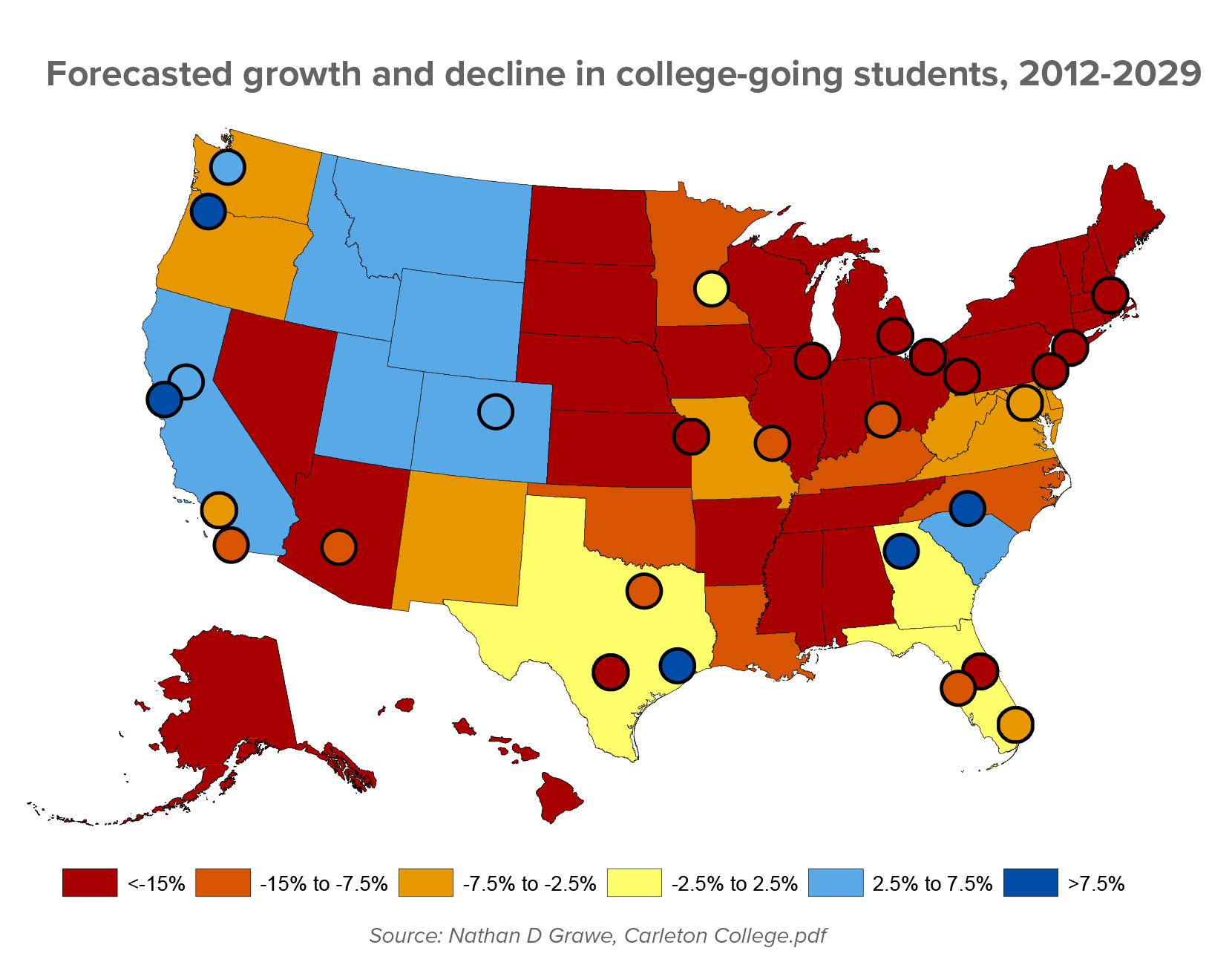
Source cupahr.org
Elite college enrollment between 2012 and 2029
Source hechingerreport.org
The Netflix Effect
Digital transformation is reshaping every industry, and higher education is right at the center of it. The pandemic accelerated this shift practically overnight, forcing institutions to adopt virtual learning as a temporary safety measure. But what began as a stopgap quickly turned into a preferred, and expected, way to learn.
Think of how Netflix replaced Blockbuster by delivering content in a more modern, accessible format. Higher ed is now experiencing a similar moment.
“This is education’s Netflix moment,” says Sean Gallagher of Northeastern University. He notes that we’ve seen a level of adoption for online education in months that would normally take years.
As students increasingly demand flexibility and digital access, institutions without a strong online strategy risk being left behind. In fact, many for-profit and digitally native schools already had online programs in place long before the pandemic. And they were the ones who saw enrollment grow while others struggled.
Industry Challengers
In addition to the digital shift, demand is also changing in what people want to learn and how they want to learn it. A global Pearson survey revealed a rising interest in shorter, skills-based programs and lifelong learning, a major departure from the traditional four-year college model. Key findings from the survey:
- 68% of respondents globally (67% in the U.S.) believe vocational or trade programs are more likely to lead to a good job than a traditional university degree.
- At least 75% of respondents in every country surveyed said you need to keep learning after college to stay relevant in today’s workforce, with the number rising above 90% in countries like Australia, Canada, China, and South Africa.
- Among those who sought additional training after being employed, most turned to self-learning via online resources or courses provided by employers, not traditional colleges.
- Three out of four people feel colleges focus too heavily on young students and should cater more to working adults.
The survey emphasized this as a moment of disruption in higher education. Students and professionals alike are rethinking what kind of education truly prepares them for a career — and what’s actually affordable.
“Many around the world feel education somehow isn’t working for them. It’s failing their generation, not preparing them for work, is too costly, or out of reach.”
Not surprisingly, tech companies have rushed to fill that gap.
Google, for example, has launched its own six-month programs, Google Career Certificates, in areas like data analytics, UX design, and project management, delivered through Coursera. Google now treats those certificates as equivalent to a four-year degree when hiring. The appeal? Affordability, speed, and direct job alignment.
Google isn’t the first or last entrant into the e-learning space, but when a brand of that scale enters your industry, institutional leaders have to stay alert, responsive, and agile.
Is the Enrollment Cliff Overblown?
Media coverage of the enrollment cliff has been widespread, highlighting the potential financial fallout for colleges and universities. While the risks are real, the impact will vary widely by institution, and the situation may not be as dire as some reports suggest. Here are some potential reasons why.
Non-Traditional Students
One key factor that can help offset the demographic decline is the growth of non-traditional students, those aged 25 and older, working professionals, part-time learners, and career changers. According to the National Center for Education Statistics (NCES), the number of students aged 25+ grew by about 16% from 2010 to 2020.
Following the pandemic-driven enrollment decline of 2020 to 2021, private, not-for-profit institutions saw a 3% increase in enrollment for students aged 25 and above between 2022 and 2024, while public four-year institutions experienced little change. This trend shows the potential of tapping into alternative student populations to maintain stability.
Distance Education as a Revenue Stream
The pandemic accelerated the adoption of online learning, nearly doubling the number of students enrolled exclusively in distance education. According to NCES, 75% of students took at least one online course in 2020, up from 36% in 2019.
This shift has lasting implications: The global online education market is projected to reach $350 billion by 2025, highlighting the enduring impact of digitization on higher education.
Online programs provide flexibility for single parents, full-time workers, and other non-traditional learners, creating a more stable revenue stream that can help institutions offset enrollment declines.
Record Enrollments and Nationwide Growth
Despite demographic headwinds, many colleges reported record enrollments for fall 2024, including:
- The University of Michigan
- The University of Mississippi
- Ohio State
- Indiana University Bloomington
- Dordt University
Nationwide enrollment growth for four-year public and private not-for-profit institutions suggests that the worst-case “cliff” scenario may be softened by strong recruitment, in-state financial aid, and flexible program offerings.
Time Horizon and Supply & Demand
Much of the alarm around the enrollment cliff stems from projections of a 15% drop in high school graduates by 2030. However, NCES data estimates a smaller decline of about 7% from 3.8 million in 2025 to 3.57 million in 2030.
From a short-term perspective, the drop looks like this:
Analysis as shown in Synario
When viewed within a broader 20-year perspective on enrollment growth, the decline appears less dramatic.
Analysis as shown in Synario
Here’s how the decline in high school graduates appears when viewed over a 20-year span instead of just five.
Analysis as shown in Synario
While some small institutions have already closed due to steep enrollment drops, many colleges are positioned to weather these shifts if they maintain strong financial planning and scenario modeling.
How to Identify Your Sensitivity to the Enrollment Cliff
Considering factors like the rise of non-traditional students, growth in online learning, record enrollments at larger institutions, and a moderate projected decline in high school graduates, the enrollment cliff may pose more of a manageable challenge than a full-blown crisis for most colleges.
That said, it still requires serious attention.
The impact won’t be uniform; some institutions will feel it more acutely than others. To understand their financial sensitivity to the enrollment cliff, colleges should evaluate key factors such as:
- Size of Institution: Smaller colleges are more sensitive to enrollment shortfalls. Missing 100 students at a school of 30,000 is manageable; missing the same at a school of 1,000 can be catastrophic.
- Reputation and Acceptance Rates: Institutions that admit far fewer students than apply face lower enrollment risk.
- Recruitment and Marketing: Effective, targeted outreach to prospective students and families strengthens enrollment resilience.
- Revenue Diversification: Schools heavily reliant on net tuition are more vulnerable to enrollment fluctuations.
- Retention Rates: High retention secures future revenue and improves financial stability.
- Geography: The enrollment cliff is expected to hit hardest in the Northeast and Midwest, requiring extra planning for institutions in these regions.
- Discount Rate vs Cost of Instruction: Analyze tuition discounts against instructional costs. High enrollment isn’t always financially sustainable if each student costs more than they bring in.
- Growth Rate Against Inflation: Revenue growth must keep pace with inflation to mitigate financial risk.
- Overall Financial Health: Understanding the institution’s financial position is essential for long-term planning.
These aren’t the only factors an institution may consider, but they are key to understanding sensitivity to the enrollment cliff.
Even if your institution doesn’t face immediate risk, having a contingency plan is essential. In times of uncertainty, understanding your institution’s odds and strategic options is critical to making informed decisions.
The Solution: Differentiation and Agile Planning
Whether or not the enrollment cliff fully materializes, colleges and universities will always face unexpected black swan or predictable, yet often ignored gray rhino events that can disrupt operations and finances.
Effective financial modeling and forecasting — including smarter long-range planning, advanced scenario analysis, reliable sensitivity planning, and precise ratio modeling — provide the insights needed to plan proactively, support strategic investments, and maintain growth and resilience in an evolving higher education landscape.
By modeling the multi-year impacts of decisions and investments and exploring new scenarios, institutions can uncover opportunities and mitigate risks they may have previously overlooked. And with a flexible modeling platform like Synario, your team can make confident, consensus-driven decisions that align with long-term goals in just a few clicks.

9 Strategies to Survive the Enrollment Cliff
Download the whitepaper to get actionable strategies and prepare your institution to thrive through the enrollment cliff.
